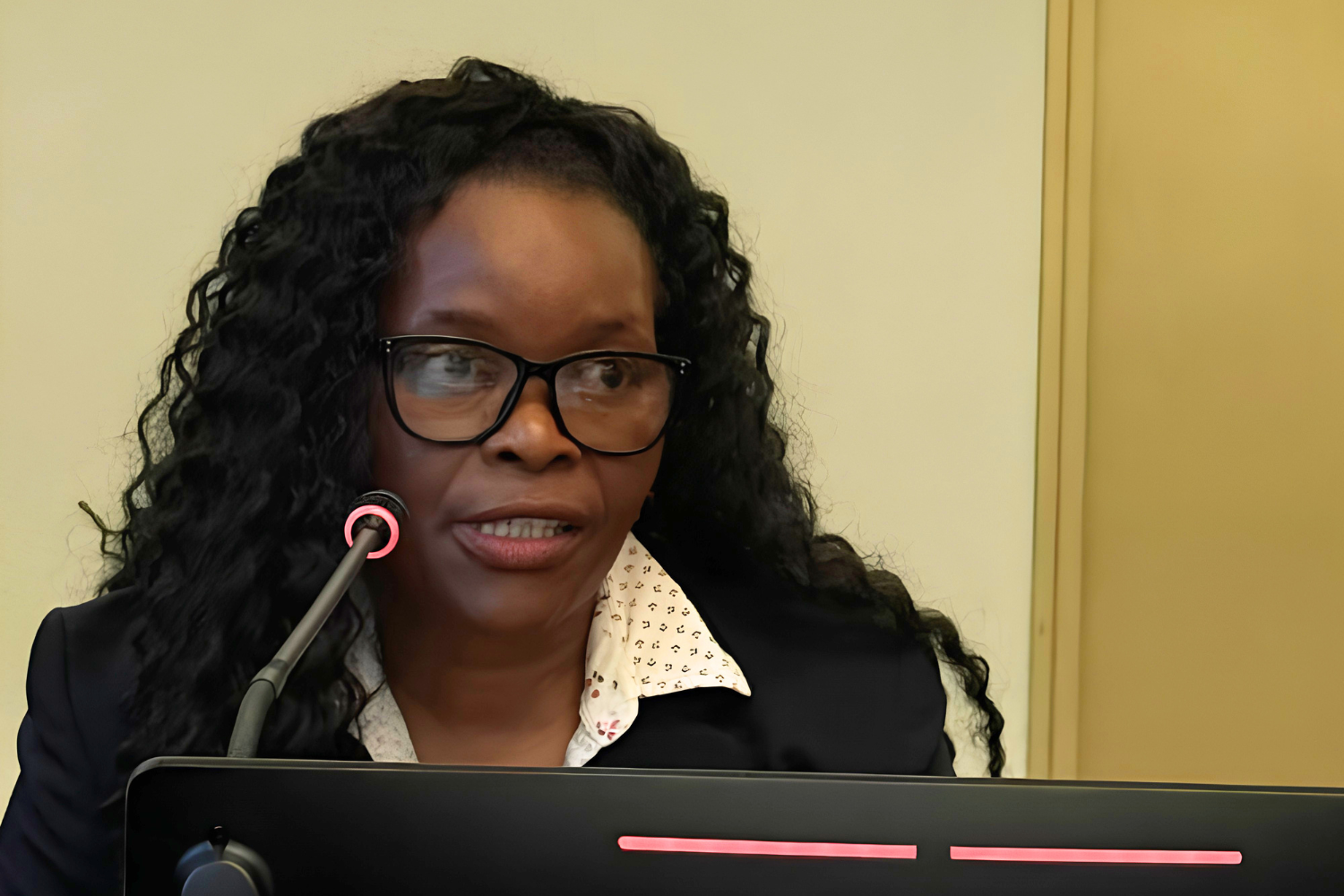
GENEVA: On Wednesday, at the pre-session for the Universal Periodic Review’s 53rd session, Every Woman coalition member Thuli Maziya from Eswatini took the floor.
Thuli, the Executive Director of Sinatsisa Lubombo Women and Girls Empowerment Organisation, delivered a statement on the urgent need for the government to fully implement the Sexual Offences and Domestic Violence Act. She called for a dedicated budget for the Act, fully resourced survivor centres in every region, trained police and judicial officials, and public reporting on case outcomes. Her full statement is below.
Every Woman extends special thanks to UPR Info, which invited Thuli to speak and brought together civil society organisations for the pre-session.
The statement
Distinguished delegates,
My name is Thulisile Maziya, Director of the Sinatsisa Lubombo Women and Girls Organisation, working in the Lubombo Region of Eswatini and a coalition member of Every Woman.
At its third review on 8 November 2021, Eswatini accepted 156 of 222 recommendations. Eswatini has since passed the Sexual Offences and Domestic Violence Act with its regulations, established domestic violence courts, and adopted a National Strategy to End Violence. These are real gains. However, the commitments that matter most to the women we work with have not been delivered, and I want to tell you what that means in practice.
Shelters and survivor services — recommended by Serbia (118.184) and the United Republic of Tanzania (118.191) both supported by Eswatini
Serbia recommended that the Government of Eswatini establish shelters for women in need. Tanzania also recommended that the Government of Eswatini increase the number of safe houses. Today, three safe houses serve the entire country, against the Government’s own target of two per region. Three one-stop centres serve all four regions, and they operate only eight hours a day, though violence against women and girls is not confined to business hours. In the Tinkhundla region, Shewula, Mhlumeni, Lomahasha, Nkilongo — where we work, there is nowhere safe for a woman to go. The Swaziland Action Group Against Abuse reports that 47 per cent of women and girls who came forward had already sought help elsewhere and not received it. Almost half of these women and girls were asking for help a second time.
Training and the justice response — recommended by Canada (118.179) supported by Eswatini
Canada recommended that the Government of Eswatini accelerate a multisectoral approach, including training for law enforcement, victim support services, and accountability of perpetrators. Eswatini’s Commission on Human Rights and Public Administration identified the same need in 2020. Today, the National Strategy records a backlog of gender-based violence cases in the courts, no case management system to track which cases are prosecuted, pending or withdrawn, and no forensic laboratory capacity. We do not have any official estimate of the size of this backlog, which is itself part of the problem: there is no official data. From the examples shown, however, the delays are real. According to the United Kingdom Foreign, Commonwealth and Development Office, rape and sexual assault cases in Eswatini can take from one to five years to reach trial. DNA samples are also sent to South Africa for forensic laboratory analysis, which often adds further months of delay.
Customary law and traditional authority — recommended by Uganda (118.190) and Australia (118.194) both supported by Eswatini
Uganda recommended that the Government of Eswatini strengthen the legal framework to eradicate harmful traditional practices that discriminate against women and the girl child. Australia recommended that the Government work with the judiciary, communities and traditional leaders to implement the Act. Our National Strategy still records early marriage being overlooked under customary law. One woman we support, a mother of three, faced daily abuse for years. When her family tried to report it, they were turned away and she was told to preserve the marriage. No legal remedy followed. This is the pattern, not the exception.
The scale, and the funding
The Government’s National Surveillance System on Violence recorded 15,987 cases of interpersonal violence in 2021, against 9,102 in 2017. Almost seventy per cent of these survivors were women and girls. The National Strategy carries a costed plan of E46.8 million (US$2.9 million). This is the second time: Human Rights Watch found the previous 2017–2022 strategy was neither fully implemented nor funded.
We therefore ask states to recommend that the Government of Eswatini:
- Allocate a dedicated annual budget for the SODV Act from the 2027 fiscal year, covering survivor services, training and prevention, and report to Parliament.
- Open fully equipped one-stop survivors’ centres in all four regions, including Shiselweni, with government-funded shelters in the Tinkhundla region where no services exist, and provide economic support for survivors.
- Train all police, prosecutors, judges and court officials on the Act within twelve months, and resource existing Domestic Violence and Child Protection units in every region within eighteen months.
- Establish fast-track courts with witness protection and forensic capacity, together with case management systems, and publish annual data on cases prosecuted, pending and withdrawn.
- Align customary law with the Constitution and with CEDAW, led by the Ministry of Justice and Constitutional Affairs, by 2027.
- Develop a national femicide prevention and monitoring strategy, with disaggregated data and annual public reporting.
- Ratify the ILO Violence and Harassment Convention of 2019, and enforce sexual harassment protections in domestic and informal employment by 2027.
Eswatini has built the framework and written the plan. What remains is the will to implement it. We thank the states that raised these issues last cycle, and ask them to return to them in November.
Thank you.